
Understanding the Working Time Act guidelines
What the warnings and violations in time tracking mean
Servire checks every clock-out entry against the Working Time Act (ArbZG). Clocking in is never blocked: a violation is documented, not prevented, to ensure the record remains complete.
The hints
-
Break missing and Break insufficient (§ 4 ArbZG): A 30-minute break is mandatory for work exceeding 6 hours, and a 45-minute break for work exceeding 9 hours. Only clocked breaks of at least 15 minutes are counted.
-
Working too long without a break (§ 4 ArbZG): No one may work for more than 6 hours continuously without a break.
-
Maximum daily working time (§ 3 ArbZG): The system adds up the working time of all entries for a workday from 6 a.m. to 6 a.m. and compares it to the set limit, which is 10 hours by default.
-
Minimum rest period (§ 5 ArbZG): There must be 11 hours between two workdays, or 10 hours with compensatory rest in the hospitality industry. A split shift on the same day does not count as a rest period and is not checked.
-
Rest period reduced, compensatory rest required: Only applies if the set limit is 10 hours. Servire reminds us that the reduction in training time must be compensated for within a month by a rest period of 12 hours.
Warning or violation
Missed breaks are warnings, while exceeding the daily working hours and insufficient rest periods are violations. Both are indicated by a warning triangle in the All Entries list, compiled in the Compliance Report, and, if enabled, sent to you by email each morning.
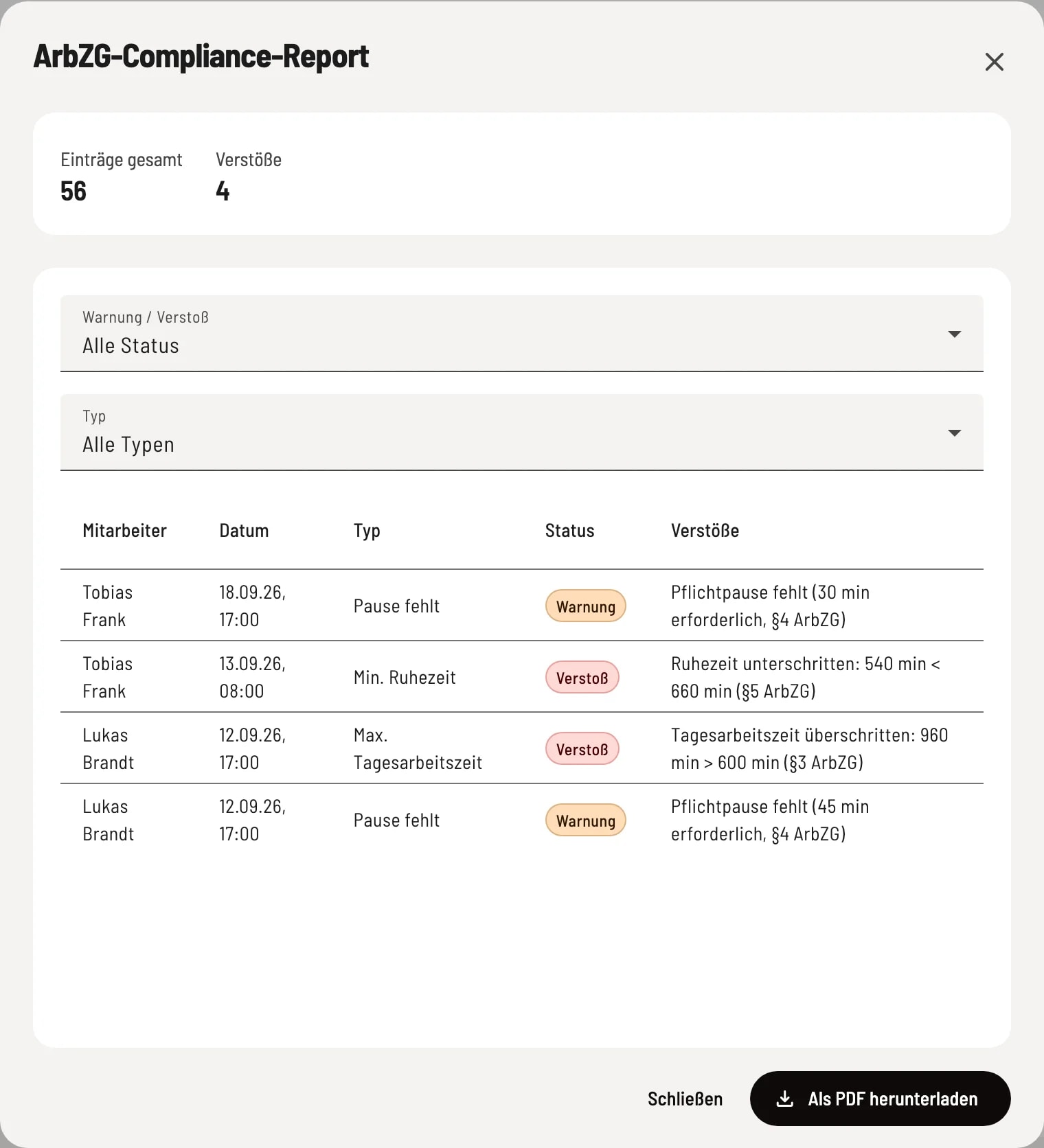
The automatic break deduction does not remove the warning. It only reduces the paid time. Any break actually taken must be clocked in.
The system does not check compliance with youth employment protection laws: stricter limits apply to employees under 18 (Youth Employment Protection Act), which the service does not recognize. The time tracking system also does not record vacation or sick leave.