
Understanding time tracking settings
What the rules for breaks, rounding, limits, notifications and surcharges mean
You can access the settings in the web desk under Employees via the gear icon in the upper right corner. These settings apply to the entire company and affect all entries that are clocked out or edited after saving.
Basics
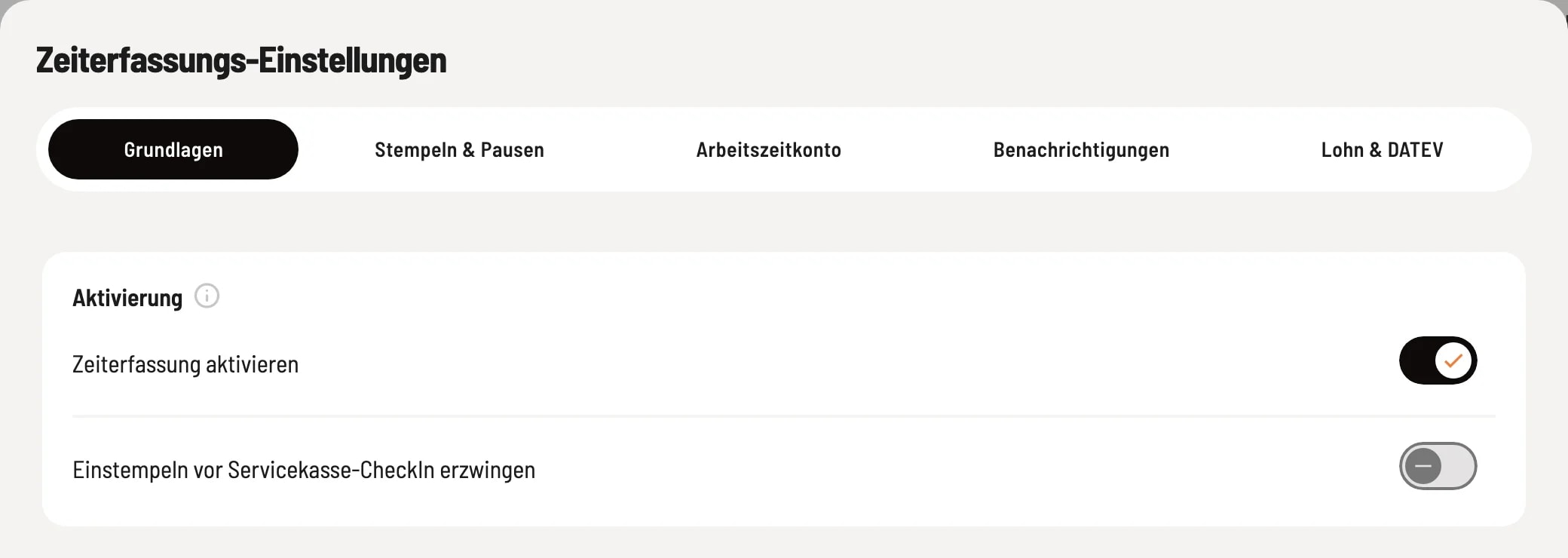
Activate Time Tracking toggles the module on or off. All records are retained when deactivated. Force Clock-In Before Service Check-In: Anyone wishing to check in at a service check-in must clock in beforehand. Otherwise, the check-in will display the message Time Tracking Required with a clock-in button. This only applies if you are using service check-in terminals.
Stamps & Breaks
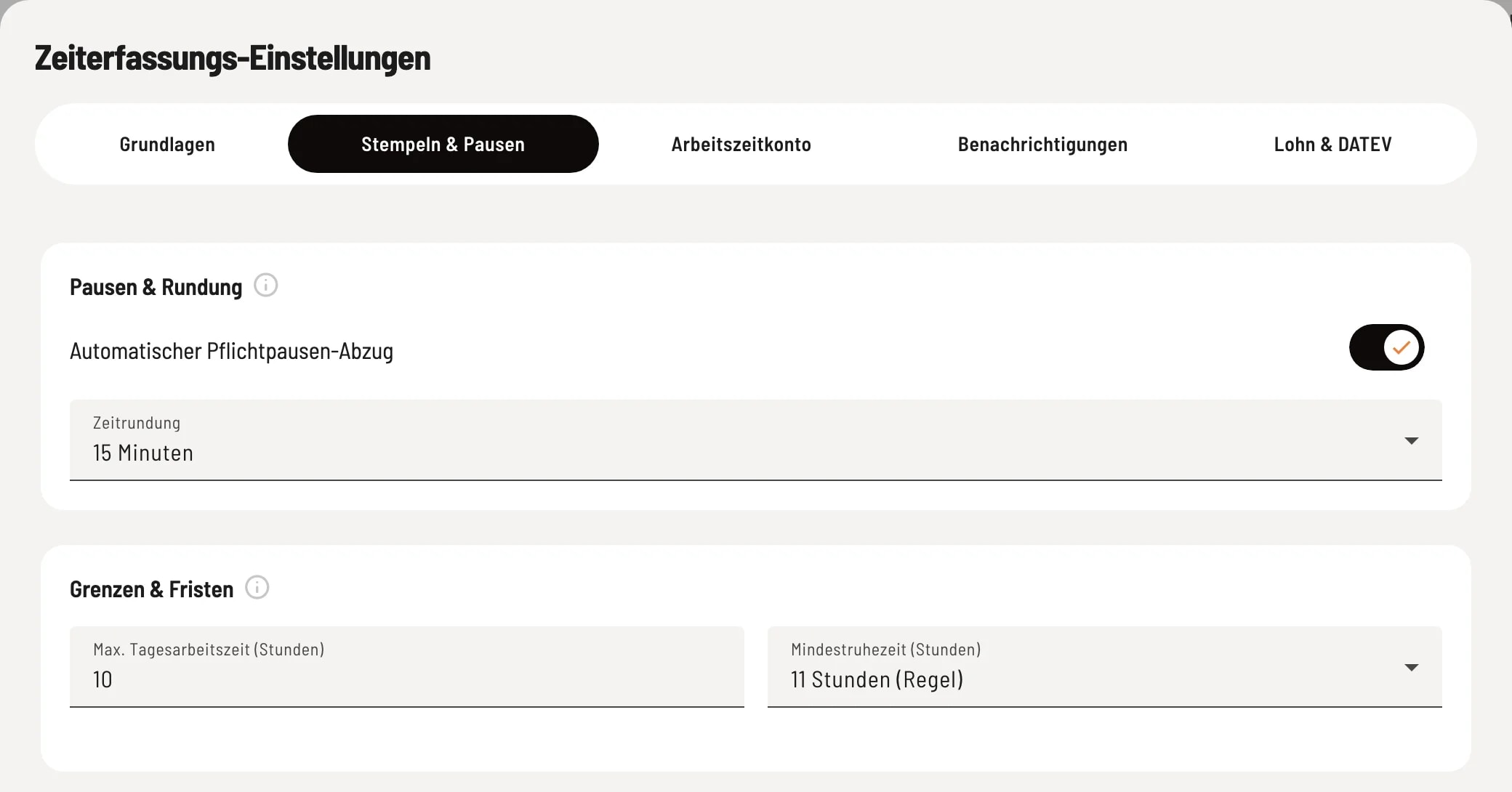
Automatic mandatory break deduction: If the legally required break is missing, Servire deducts the missing time from the paid time. This is 30 minutes for more than 6 hours of work and 45 minutes for more than 9 hours. Clocked breaks are included. The deduction does not replace a break: The missing break remains as a warning in the Working Time Act (ArbZG) report. Time rounding only rounds the paid time of each entry up or down to the nearest 5 or 15 minutes. The clocked times and the actual duration remain unchanged. Maximum daily working time and Minimum rest period determine when Servire reports a violation. Clocking in is still possible, but the violation will appear in the report. Legally, up to 10 hours per day and 11 hours of rest period are permitted; in restaurants, 10 hours of rest period are allowed if it is compensated within one month.
Working time account
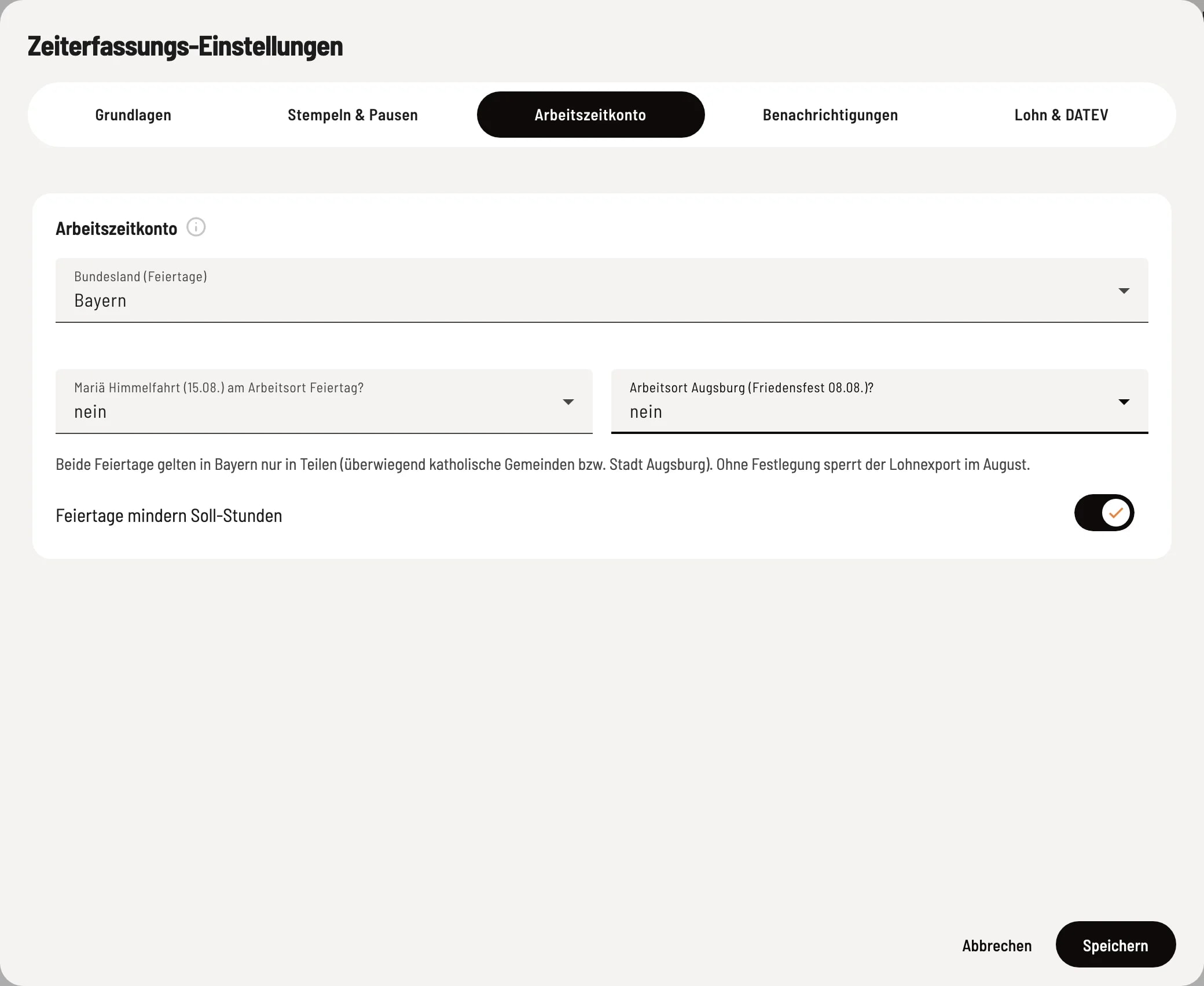
Federal State (Public Holidays) determines which public holidays apply. This is mandatory whenever public holidays reduce the target hours or surcharges are calculated. Public Holidays Reduce Target Hours reduces the weekly target hours by a certain percentage on a public holiday, regardless of the day of the week it falls on. Vacation and sick leave do not reduce the target hours. In Bavaria, you also specify whether Assumption Day (August 15th) is a public holiday at the workplace and whether the workplace is Augsburg (Peace Festival, August 8th). Both of these days are only observed in parts of Bavaria, and the holiday surcharges are calculated accordingly. Without this specification, payroll export for August remains blocked.
Notifications
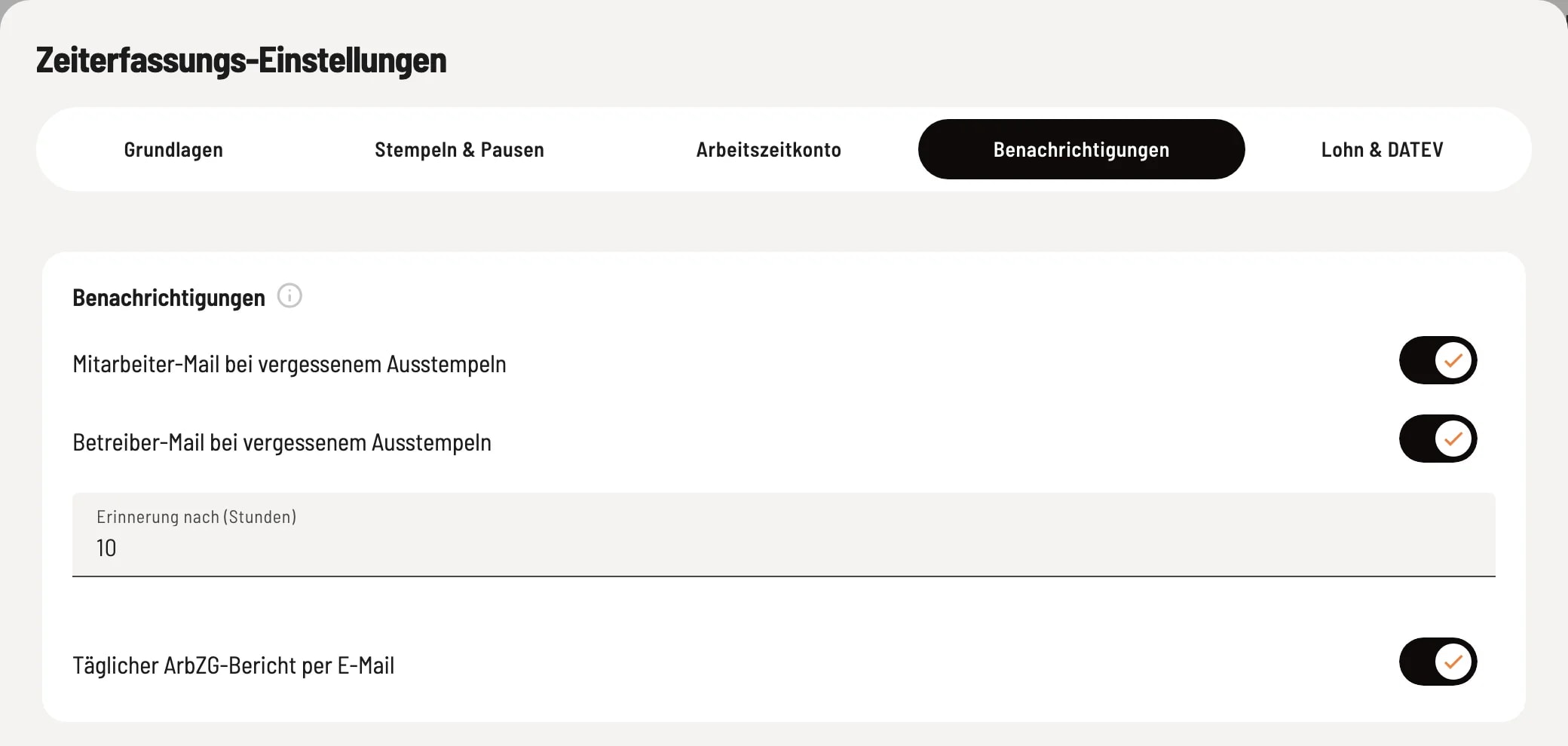
Employee Email and Company Email for Forgotten Clock-Out: If someone is still clocked in after the time indicated by the Reminder After, a reminder email will be sent to that person and to all employees listed as employers. Daily Working Time Act Report via Email: Every morning around 7 a.m., employers receive an email if there was a violation of the Working Time Act the previous day. No violation occurs, and no email is sent.
Anyone clocked in for more than 16 hours has forgotten to clock out. Servire automatically closes the entry to exactly this limit, marks it with Automatically clocked out – please check, and sends an email notification. Correct such entries as described in Correcting Time Entries.
Payroll & DATEV
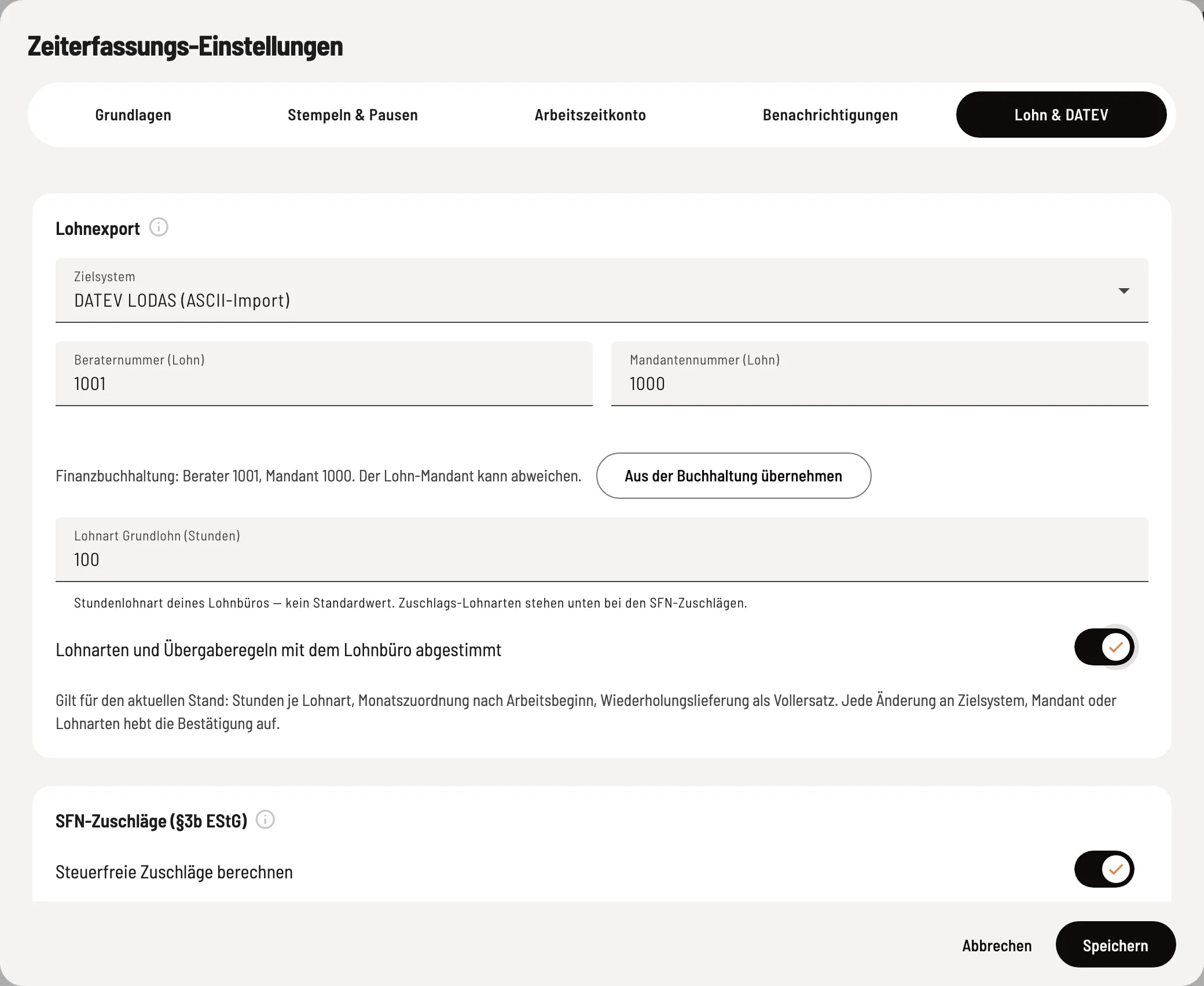
Under Payroll Export, select your payroll provider's Target System and enter the consultant number, client number, and the Basic Hourly Wage Type. Clicking the Wage Types and Transfer Rules Agreed with Payroll enables the export. The meaning of the fields is explained in the section "Setting Up Payroll Export." Calculate Tax-Free Supplements calculates night, Sunday, and holiday supplements on the hourly wage and transfers the supplement hours in the payroll export under custom wage types. The standard rates correspond to the maximum tax-free rates according to Section 3b of the German Income Tax Act (EStG): Night (8 p.m.–6 a.m.) 25%, Night (midnight–4 a.m. if work starts before midnight) 40%, Sunday 50%, Holiday 125%, High Holiday 150%. The holiday replaces Sunday, and the night supplement is added. Under DATEV Wage Types, enter the number your payroll provider uses for each supplement type. There are no default values: If a number is missing, the wage export remains blocked as soon as surcharges of this type are incurred.
Clarify the surcharge rates and wage types with your payroll department. Rates higher than the standard values are no longer tax-free, and Servire does not check this.